Friday, November 6, 2009

27. When I Lived in Modern Times by Linda Grant: Now this is the book that should have been that final 26th book of the year. This amazing story of a young British woman who moves to then-Palestine in 1946, wanting to be a part of the formation of the Jewish State. This woman who inadvertently gets herself mixed up in the Irgun. This novel of identity and belonging, this novel of incredible writing and a history that reads as if the author had lived it. This book. This fabulous, fabulous book.

Labels: ,

Thursday, October 22, 2009

26. Shopaholic and Baby by Sophie Kinsella: This is it? Book 26? This book I'm ashamed I even read. This book that I felt dirty reading, even as I was doing so? I was in the library, looking for something light, anything frothy, and I ended up with this. Shopaholic girl gets pregnant. Choose celeb OB. Celeb OB happens to be Shopaholic's husband's ex girlfriend. Hilarity ensues! Or not. Yep. I say definitely the latter.

Labels: ,

Tuesday, October 20, 2009

25. The Shiksa Syndrome: A Novel by Laurie Graff: Hey, it's a book about Jews who hate themselves! How very Woody Allen! But, you know, without the wit, subtlety, or intelligence. Aimee is a fairly observant Jewish woman who starts off with a non-Jewish boyfriend, who is an all-around decent guy. But when they break up, she decides she must pass herself off as a non-Jew to snag herself a nice Jewish boy who wants nothing to do with Jewish girls. Now, I don't care who marries whom in this world, but this book makes it clear that there's absolutely no hope of anyone marrying within their own faith. Fine. But haven't we gotten past this stereotype of the meddling Jewish mother? All I can say about this book is, Oy!

Labels: ,

Saturday, October 10, 2009

24. What Happened to Anna K.? by Irina Reyn: A friend posted this on her Goodreads list, and it intrigued me. When I was a freshman in college, I was determined to get through Anna Karenina because... well, I don't know why because. I assume now it's because I was 18 and I was too smart for contemporary literature and I was a tortured soul who had to read about other tortured soul, but I wasn't that tortured, as I owned a teddy bear that I named Count Vronsky. Yes, a teddy bear. Can you say, "irony"? Or maybe the word is, "imbecile"? I really did read it, although I confess to skimming some of Levin's political diatribes.

I was intrigued with the idea of this modernization of the novel, and I was not disappointed. Anna, this time, is a Jewish Russian immigrant, living in Rego Park in Queens. The modern-day setting fits and the story is engaging, with enough of the original (without all the politics to weigh it down) to make is a great read. Reyn has a tremendous eye for detail, something I'd love to emulate myself, and her characters come alive.

Labels: ,

Tuesday, September 22, 2009

23. Handle with Care by Jodi Picoult: Yikes, let a little time slip by without recording books and it's easy to forget what I've read. Can't let that happen again.

I lent this book to a friend and as I told her, this is one of those books I really enjoyed while I was reading, but when I got to the end, I felt rather cheated. It's her standard child-in-danger book, and it was an interesting premise: a girl with brittle bone disease whose mother sues for wrongful birth. But the story was way too long with some subplots that didn't quite come together. The editing in this book was nonexistent--both line editing and copy editing. If you're on vacation, you might like this read. It hasn't turned me off of Picoult--I've heard her earlier books are quite good--but it's definitely made me wary of later books of authors who churn them out by the year.

Labels:

Wednesday, September 2, 2009

22. The Time Traveler's Wife by Audrey Niffenegger: I so didn't want to like this book. All the hype and the stupid trailers that make it look so maudlin. But the truth is, I couldn't resist this book. The story of Henry who suffers from a genetic disease that causes him to time travel, and Clare, the woman who's known Henry (as an adult) since she was six, was truly captivating. True, a few portions felt overlong and overdrawn out, but over all, I looked forward to reading this. The ending was vaguely unsatisfying, and I don't wish to spoil it, but it felt like it was pandering to an audience that wanted a happier ending. I prefer messy endings. But still, a great read. And, no, I don't want to see the movie.

Labels: ,

Tuesday, September 1, 2009

21. The Impostor's Daughter: A True Memoir by Laurie Sandell: Okay, so calling this one of my books feels a little like cheating, as it's really a graphic novel, but what a fun novel it is. Laurie's father was a secretive man with a habit of filching large sums of money from those he loved. Laurie grew up with some severe daddy issues, which she exploits to our amusement in this book. The benefit of the graphic novel format is that we can never take her too seriously so incidents that would seem maudlin in a prose format come off as light-hearted. That's both a benefit and a detriment, but she manages to get her story across. This was the fastest read of the summer--I finished it in a day--but it was a day well spent.

Labels: ,

Friday, August 21, 2009

20. Recipes for a Perfect Marriage by Morag Prunty: A second book borrowed from my friend Fay's Goodreads list, and this one, definitely a read worth checking out. What a beautifully written story! Tressa is a modern-day cooking expert, who, at 38, rushes into a marriage only to realize that she's married the wrong man. She longs for a marriage like her grandmother's. Tressa's Manhattan life is interspersed with chapters (and recipes) of her grandmother's life in Ireland in the 1930s. The Tressa chapters are good, but the grandmother chapters are captivating and really encapsulate a beautiful (non)romance. The lives are starkly parallel, yet each reconciles herself in her own way in a story I didn't want to end. This was a perfect summer read.

Labels:

Wednesday, August 12, 2009

19. This Side of Married by Rachel Pastan: My friend Fay had this book on her Goodreads list, and it looked interesting so I promptly stole it for my own list. I can only say, Fay, don't waste your time. I love a good piece of chick lit, and this was not it. Supposedly a modern day Jane Austen tale, this novel is trite, one dimensional, and boring. The mother, a successful doctor, is trying to make sure her three daughters are all happily married. But the daughters are so single minded, I can't imagine who would want them. The twists are predictable, the writing flat, and the whole thing completely unfulfilling. Sorry!

Labels: ,

Saturday, August 8, 2009

18. Unchosen: The Hidden Lives of Hasidic Rebels by by Hella Winston: What an interesting look at people who choose to leave the Hasidic lifestyle. I found this book quite compelling and it brought up situations that never would have occurred to me. I had no idea that in my Hasidic communities in the U.S. people spoke Yiddish primarily and that English is very much a second language. The problems people face when they try to leave seem almost insurmountable, so it's amazing that anyone does leave.

Winston follows a handful of people as they try to leave their Hasidic communities, but these people (especially men) have extremely poor education (the men get almost no secular studies), no knowledge of the customs and mores of the outside world, and nowhere to go to simply get themselves settled. Many, it appears, turn to substance abuse. It's ultimately a sad tale; those who don't have sympathetic non-observant relative can really isolate themselves. An interesting read, but after these negative views of Hasidic life, I'd really like to read something that shows the other side of things.

Labels: ,

Saturday, August 1, 2009

17. Mystics, Mavericks, and Merrymakers: An Intimate Journey among Hasidic Girls by Stephanie Levine: This book looks at teenaged girls in the Hasidic Lubavitch community. You could call this book research for my own writing, and while I did enjoy the looks at the individual girls, I found that this book was too much of what I think it was supposed to be--an academic paper. I didn't care so much of the sociological ramifications in a greater community, I just wanted more of the girls. The young women profiled were certainly diverse--people interested in leaving, people who were truly embracing the religion, people who were trying to mix careers in the secular world with the religious life. It would be quite interesting to have more follow-up on these young women. The book was insightful and helpful for me, but was not a gripping read, I'm afraid.

Labels: ,

Tuesday, July 21, 2009

16. Bad Mother: A Chronicle of Maternal Crimes, Minor Calamities, and Occasional Moments of Grace by Ayelet Waldman: Okay, here it is: I don't think Waldman sounds like a bad mother. And my main fault with the book is that she seems like a normal, decent person. Yes, let's face it; I read the book to feel superior and better about my own mothering. But Waldman actually spends a great deal of time trying to show us that she's really a very good mother as in for, example, when her son can't breast feed, she pumps for months and months. I was hoping for more "bad mom" stories and examples, ways that she was going to show that we all need to be a lot more supportive in the parenting arena and that we all have the ability to be a good and bad parent. That wasn't here.

So let's put aside the issue of "bad mother" and then I can say it's really a very fun, very engaging memoir. Waldman's life is not one most of us can relate to--she was able to go from Harvard-educated lawyer to writer while her work-at-home author husband takes up a lot of the day-to-day chores--but her writing is honest, whether dealing with her bipolar issues or the abortion of a child who could have had special needs. Despite her woes, her life comes off as quite privileged, however her voice is refreshing and I think as a "momoir," this book succeeds wonderfully.

Labels: ,

Wednesday, July 15, 2009

15. Buying Dad: One Woman's Search for the Perfect Sperm Donor by Harlyn Aizley: There is plenty to like in this memoir of Aizley trying to find the perfect sperm donor so she and her partner can have a baby. Her neurotic Jewish, lesbian take gives a rather mundane tale of infertility, sperm seeking, and pregnancy a different spin.

That said, I never really sunk into this book. I can't put my finger on why. I pulled this book off the Starbucks free book shelf, so it was really a random pick. Aizley has a delightfully snarky tone and she's self-deprecating in a most amusing way. But I kept putting the book down, only to go back to it when the other book I was reading was too far away for me to get out of bed to retrieve. Yes, that's right. I'm a lazy reader.

I think it's perhaps that other than the "neurotic Jewish" aspect, I didn't connect on any other levels. Had I had difficulty conceiving, I think this book would have been a terrific read. But as it is, I was most interested in the parenting aspects, of which there were none (the story ends with the birth of their child). I think I wanted more of her relationship with Faith, as that was the fun part--their dynamics were infinitely relate-able. A thread also weaves throughout about Aizley's mother's cancer, a very somber story that is told with a good deal of levity. This too was quite interesting to me.

I think if Aizley writes other books, I'd most likely be interested in them. It was just the subject matter here that kept me from becoming really enmeshed.

Labels: ,

Sunday, July 12, 2009

14. The Marriage Bureau for Rich People by Farahad Zama: I saw this at Barnes and Noble and immediately put it on my library request list (I do make a point of buying books, because I think it's important to support writers, however, I'd go broke buying every book I have a whim about, so I figure, buy one book a month and library the rest). I have to say, the book fooled me a bit; I thought it would be more literary, but really, by the end, it was a basic chick lit romance. However it was so cleverly disguised in the society and cultures of India that I was seduced.

Mr. Ali is retired and decides to supplement his pension by opening a marriage bureau for arranged marriages. His assistant is a young woman whose family is unable to afford a wedding for her, so she must remain unmarried. Mr. Ali has a son who is involved in protests, causing Mr. Ali and his wife great distress. The story lines are fairly simple and the conclusions are fairly facile, but Zama goes into such detail into Indian life--how and why marriages are arranged; why love marriages are discouraged; what people eat; how people behave; the mingling of Muslim and Hindi neighbors--that I was drawn into the story and looked forward to reading it. The writing verges on clunky at times, but so what. This was the perfect summer read--light, fun, and yet a window into a different world from mine.

Labels:

Tuesday, June 30, 2009

13. Wishful Drinking by Carrie Fisher: The rifts in this book began as a stage show, and it's obvious from the tone of the writing. It's short--it can be read in one decent sitting--and it doesn't go nearly into enough depth, and the style takes a chapter to get into.

But who cares? This book is a voyeuristic, witty, and fun peek into Fisher's life as a daughter of Hollywood, a failed wife, a drug addict, a mother, an actress. She doesn't hold back as she rips into everyone, but mostly herself. I laughed while reading this. By the end of the book, Fisher feels like an old friend, one you'd love to have a drink with (that is, if she could drink, but as a recovering drug user, I suppose that's not very likely). If ever a book was a guilty pleasure, this is it.

Labels:

Friday, June 26, 2009

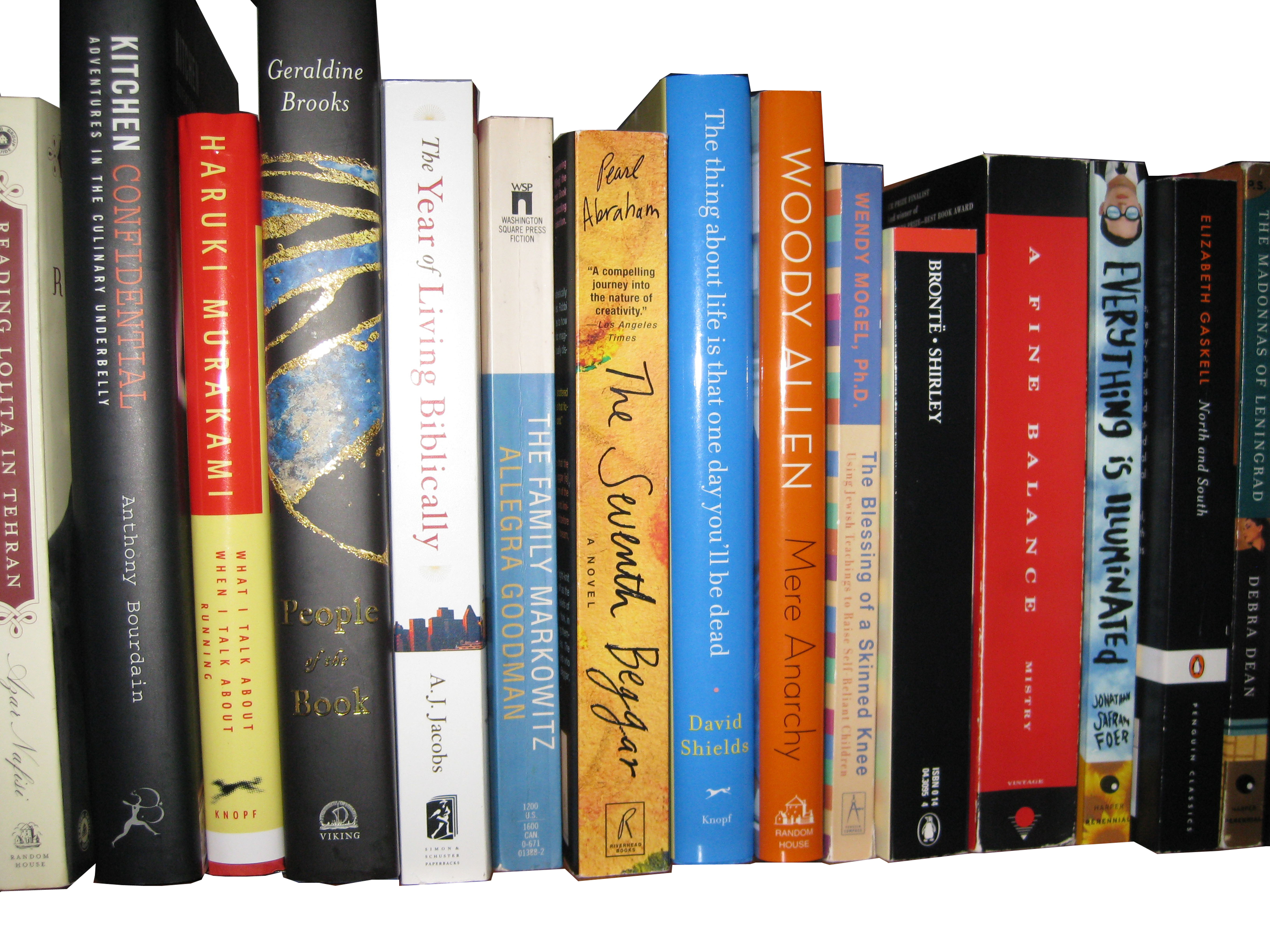
12. People of the Book: A Novel by Geraldine Brooks: I am a sucker for this kind of novel. I thought James Michener's The Source was one of the clunkiest, poorly written books I've come across, and yet I was riveted--fascinated by the layers of stories told around a single archeological site in Israel. Brooks does the same sort of thing here, only each piece of her novel revolves around the Sarajevo Haggadah, a real book that has been rescued time and again over the past five centuries.

Brooks uses the same structure--Hannah is a book restorer who uses her skill to reveal clues (and she even has a romance just as in Michener's tale), and Brooks uses those clues to weave stories about the book in a particular period. From the books rescue from Nazi destruction to its saving during the time of the inquisition to the very writing by the sofer and the painting of the illuminations. The work is fiction and Brooks is merely imagining what might have happened, but oh what a great imagination she has! I'm not even close to a historian, so I have no idea if what she's conjured is plausible, but frankly, I didn't care. I was sucked in and swept away. Interestingly, much like the Michener novel, the weakest part was the framing story of Hannah, but still, this is a minor complaint and I actually found Hannah quite likable, even in her coldness (she isn't the warmest woman, but I liked that about her); merely her story wasn't as rich and couldn't live up to the other pieces of the book. Really enjoyed this. I'll have to into her other fiction.

Labels: , ,

Monday, June 15, 2009

11. The Seventh Beggar by Pearl Abraham: I so enjoyed Abraham's first book (Romance Reader) and I found her second to be good (Giving Up America). This book was... oddly interesting. But I never really got into it. Abraham's novel is fascinating, but disjointed and I found parts of it, frankly, over my head. The story is in two parts, the first about a Hasidic boy, Joel, who becomes obsessed with Kabbalist ideas about creating a being. Joel comes to a tragic end and part two centers on his nephew, JakobJoel, who as an MIT student is also working on artificial beings. Interesting. But her forays into the magical realism and Hasidic folktalkes and all sorts of tangents didn't let things cohere for me. They were beautiful and other worldly, but it didn't sit right with me.

I was especially disappointed, because it feels like a long time since I've really lost myself in a book. I had two aborted efforts--Bad Girls Go Everywhere: The Life of Helen Gurley Brown and Buying Dad: One Woman's Search for the Perfect Sperm Donor. The latter was taken from the "take a book" shelf at Starbucks, and it just isn't that interesting. The first I'm actually interested in the subject, but I wasn't crazy about the author's take. She was trying too hard to justify Brown as a second-wave feminist, which I don't need convincing about. So I abandoned both of those, which doesn't help my 26 books effort (and I realize I'm behind). So at least I finished this book (and it wasn't a short book!). But I'm eager for a book I can really lose myself in. The search continues...

Labels: ,

Wednesday, May 27, 2009

10. Open Doors by Gloria Goldreich: On my quest to read all the Jewish-themed novels I can to help me in my own novel writing, I stumbled upon this book. Next time, I'll watch where I'm going. Elaine and her husband had a relationship that shut out their four children. When the husband dies, Elaine finds herself adrift, literally. She visits her ultra-Orthodox daughter in Jerusalem; goes with her stubbornly single daughter to Russia to adopt a daughter; her son who is in a troubled marriage in California; and her gay son and his partner, who she has tried to accept, but never fully succeeding, in Arizona. The big question of the novel is: With whom will she choose to live?

The characters are pretty flat--each is a cliche of its type. Elaine, who is resented by each child for her closing herself off with her husband, is able to save the day in some way for each kid. The ending kind of came from nowhere and wasn't very convincing. Sigh. Still looking for those great Jewish novels....

Labels: ,

Tuesday, May 12, 2009

9. Forgetting English: Stories by Midge Raymond: I have to preface my comments on this book by letting you know that Midge is a friend of mine; we worked together at Boston University, writing for their alumni publications, and she's an amazing, warm, wonderful person and I adore her writing. So let me say off the bat, this may not be unbiased, but I'm trying.

This collection of stories takes us around the world: Africa, Japan, Antarctica, to name a few. But the locations are merely flavor; the heart of these stories are the relationships between the people, between men and women. The settings are extraordinary and provide color and beauty. The relationships are complex and fully realized. Midge's writing doesn't disappoint and I highly recommend her collection of stories.

Labels: ,

Tuesday, April 28, 2009

8. My Jesus Year: A Rabbi's Son Wanders the Bible Belt in Search of His Own Faith by Benyamin Cohen: Cohen is the son of an Orthodox rabbi, living in Atlanta. Cohen is feeling disillusioned and unfulfilled by Judaism, so he decides to investigate Christianity, to see if there are any meanings he can take that will help him rediscover his own faith. To that end, every Sunday he visits churches, faith rallies, and meets Christian evangelicals.

My biggest complaint with this book is that it floats too much on the surface. I felt it was unclear that this entire time, Cohen is actually still a very observant Jew, keeping kosher, observing Shabbat, attending synagogue services. He mocks religion liberally, especially his own, but I thought it came off as forced. He glimpses into Christian wrestling, Mormonism, Christian rock shows, Catholicism, but he can't capture it all in a year and he doesn't delve deeply into any of the areas. The book was interesting, but it wasn't that enlightening. If you read this, read it as a memoir, not for deeper meaning or for humor.

Labels: , ,

Sunday, April 12, 2009

7. Mere Anarchy by Woody Allen: What does is say that up until the moment that I wrote this blurb, I thought that the title of this book was Mere Anxiety, which I actually think is more fitting. I adore Woody Allen. I always have. He was the first director I really followed, he's what I've aspired to, he's always been my filmic hero (and I chose not to pay attention to his personal life. I'm of the mind that you need to separate the personal from the art). Interviewing him while I was working at Amazon was probably the editorial highlight of my career.

That said, I was surprisingly disappointed by this collection. It wasn't uniformly bad--I really enjoyed a piece, "On a Bad Day You Can See Forever," about remodeling a townhouse (hmmm, wonder why), and while I thought Allen very cleverly riffed on news events, I found the style too over the top. I kept thinking that if anyone else had submitted these stories, they'd have been rejected as too slapstick. They're current pieces, and yet they felt dated.

I feel I need to defend the book, because I do feel so passionate about Woody Allen. I'll look forward to reading whatever he puts out next and I'll continue to watch his films, but this book, unlike his previous ones (Without Feathers is still brilliant), is not one I'll return to.

Labels:

Friday, April 3, 2009

6. Senator's Wife by Sue Miller: The novel is about a newly married couple who lives in one half of a two-family house, on the other side of a senator's wife. The wife lives alone because her husband is a philandering louse, although he's painted as a charming, dashing, JFK-like figure. However it's completely implausible as he's painted--he's character is two-dimensional. In fact, both husbands don't come across as fully realized characters. The younger husband, Nathan, has nothing to him and I just didn't see how their marriage worked.

The story jumps back and forth between the younger wife, Meri, and the senator's wife, Delia, and to Miller's credit, both characters are interesting and, in fact, Delia's life was more alluring and it's not often I can find a 70 plus year old character absorbing.

But the climax of the story, the final intertwining of the two characters, is too unbelievable. Meri acts in such a way that just seems, well, kind of creepy and isn't at all grounded in anything we'd seen in her character. And the final sum up was just a bit too pat for my satisfaction.

Labels:

Tuesday, March 24, 2009

5. The Liberated Bride by A. B. Yehoshua: Note to self: If trying to read 26 books in a year, don't choose longer, heavier books. That said, this book was brilliant. It's about the brides in the life of a professor of Orientalism, Rivlin, in Haifa: his wife, the bride who deserted his son after a year of marriage, and the Arabic woman who is his student and whose wedding he attends early on in the story.

I admit, selfishly, part of the reason I loved this book is the way Yehoshua set up a mystery (why did Gayla leave Rivlin's son) set an example for something I'm trying to do (with much less success, I readily admit) in my own writing. That said, this book should not be considered a mystery. The mystery is just a small part of the world Yehoshua creates, something that centers all the other relationships in the story.

Occasionally the translation seemed a little clunky, but even through the translation it's possible to see the beauty of the writing. The details are magnificent and this illuminates so much about so many relationships: between Rivlin and his wife, Rivlin and his son, the Israelis and the Arabs. This gives an intimate look to what Israeli, and to a limited degree Arabic, life was like before the intifada.

This book is haunting. Images from it just stay with me. Amazing.

Labels: ,

Tuesday, February 10, 2009

4. Raising Your Child to Be a Mensch by Neil Kurshan: This book was recommended to me by Pie's preschool director; it's out of print but I was able to find it used. Mensch is a Yiddish term that means something along the lines of "good person" (the definition I found on the web is "a person of integrity and honor").

The book was an enjoyable read, but the philosophy is one that's similar to what we already believe (and is expanded upon, I think, in Wendy Mogel's Blessing of a Skinned Knee, which I should reread now that my kids are older), so it was a bit of preaching to the choir. Raise your children with solid morals, don't overschedule them, have quality time, make sure they use manners and have respect for others, and such. Kurshan gives lots of examples, which make the book very readable. While Kurshan is coming from an Old Testament perspective, I would think it would be relevant to anyone.

Labels: , ,

Saturday, January 31, 2009

3. The Family Markowitz by Allegra Goodman: While this is a collection of short stories, they all revolve around one family, over the course of about fifteen years, giving the book much more of a novel feel. In fact, while many of the stories were strong in and of themselves, there were a few that I didn't feel stood up on their own. Because the stories were so heavily linked, though, it made me read the book as a novel, and as such, I wanted more from the characters.

The heart of the stories is the Rose Markowitz, the elderly mother of Ed and Henry who buries her second husband. Her character never came to life for me--even though she has her own story, I felt I never understood her or her motivations; every now and then I'd get a glimpse of her beyond the surface, but her character did nothing but stress me out.

The stories that interested me the most involved the younger generation: the daughter-in-law who never had the Woolfian room of her own; the granddaughter who turned Orthodox to the disbelief of her parents; the son who belongs to another era (although I was confused about the sudden about face on his sexuality).

As in Kaaterskill Falls, the writing here is beautiful, but it's obvious this is an earlier work; it just doesn't hold together as well.

Labels: ,

Wednesday, January 7, 2009

2. The Year of Living Biblically: One Man's Humble Quest to Follow the Bible as Literally as Possible by A. J. Jacobs: Four years ago, I read Jacobs's (an Esquire writer) first book, The Know-It-All: One Man's Humble Quest to Become the Smartest Person in the World, which was about his quest to read the encyclopedia from A to Z. It isn't dry like it sounds--he cleverly tied much of what he'd read to his personal life--but I didn't feel the style held together for me throughout. The episodic style, however, is perfect for this book.

The premise of the book is that Jacobs, an agnostic New York Jew, wants to better understand this book that impacts the life the majority of this country and much of the world. To do so, he decides for one year, to live a biblical life, meaning he wants to literally follow the laws set out in the bible. He spent eight months on the Old Testament and four months on the New. Of course, he finds the task to be completely impossible--he didn't take an eyes for eyes and the like--but he does a great job at exploring the Bible and those who follow it, and he manages to do it with both humor and respect. He interviews atheists, clergy members, serpent handlers; he visits the Creation Museum and Israel. He dresses in white, carries a staff, and grows a mammoth beard. Throughout it all, his wife, pregnant with twins, barely tolerates it all.

The book opens more questions than it answers, but it clearly shows Jacobs's spiritual growth. It's also incredibly funny and I found it impressive that he never spoke down about any of the folks he met (and he meets some interesting characters). I think anyone remotely interested in religion--or just humorous memoirs--would enjoy this book.

Labels:

Tuesday, January 6, 2009

1. American Wife: A Novel by Curtis Sittenfeld: I often find it hard to read fictionalized accounts of people and events because I want to separate what's real from what's made up, and of course, not knowing enough about the events, I can't. That said, this story of a first lady (Alice Blackwell) and her bumbling presidential husband (Charlie Blackwell) was an interesting, but uneven, book. Alice's early years--her younger romances, an early tragedy, her coming of age--is well done. I even bought why someone as smart and sophisticated as her would marry such a buffoon. But once Charlie takes office as president, the novel seems to just speed up, and the ending chapter felt very rushed.

My one other problem with the book is that because, as I'm reading it, I can't help but imagine President Bush and his wife, I felt kind of grossed out by the sex scenes and, um, some of the more personal aspects (do I really want to know about the bowel movement that clogged the only toilet in the Blackwell's summer home?). I'm not normally a prude about these things, but they bothered me here.

I will give credit that Charlie, as moronic as he is in the story, he is endearing, and in a warped sort of way, you can see how he was elected. He also comes off as an absolute jerk, and there were plenty of times I was rooting for Alice to leave him.

Overall, I wouldn't call this a presidential read, but it was a fun book, the perfect way to start the new year and the end of the Republican administration.

Labels: